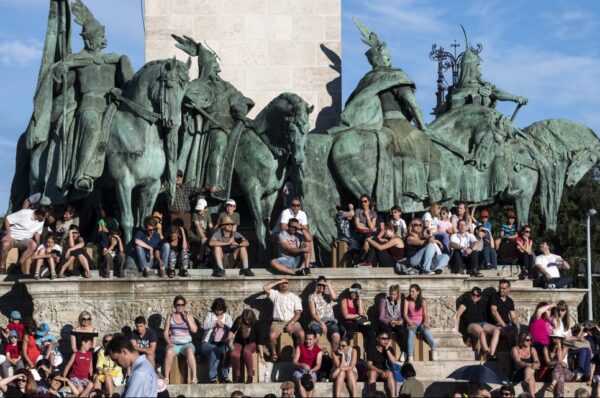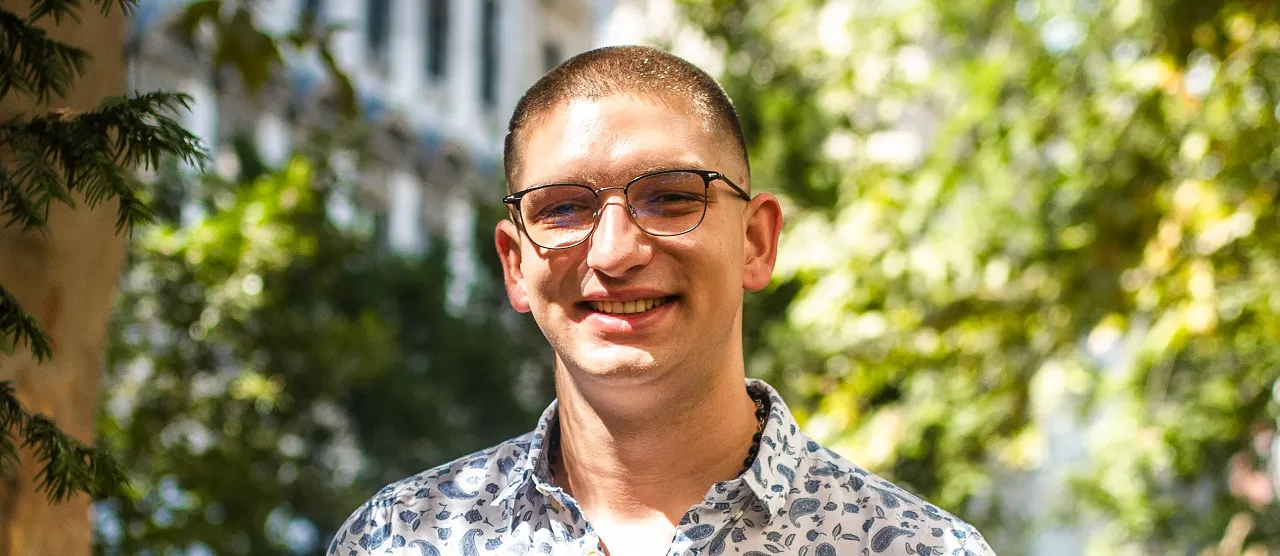
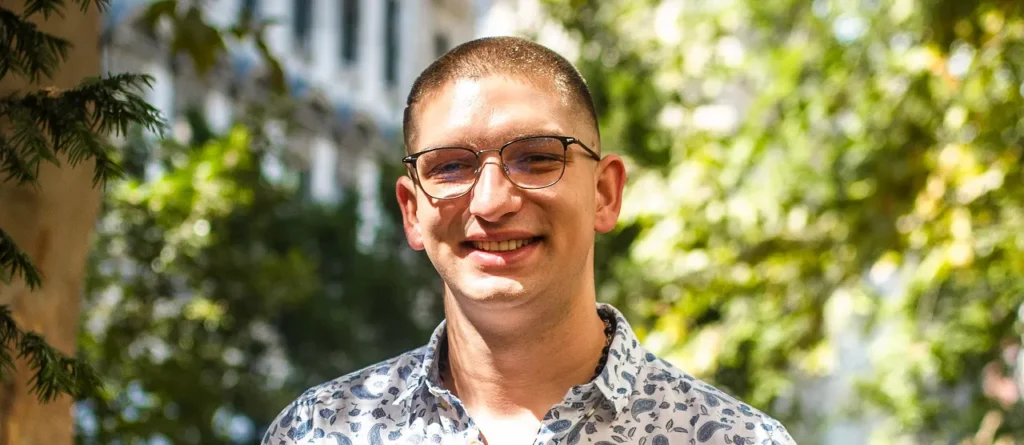
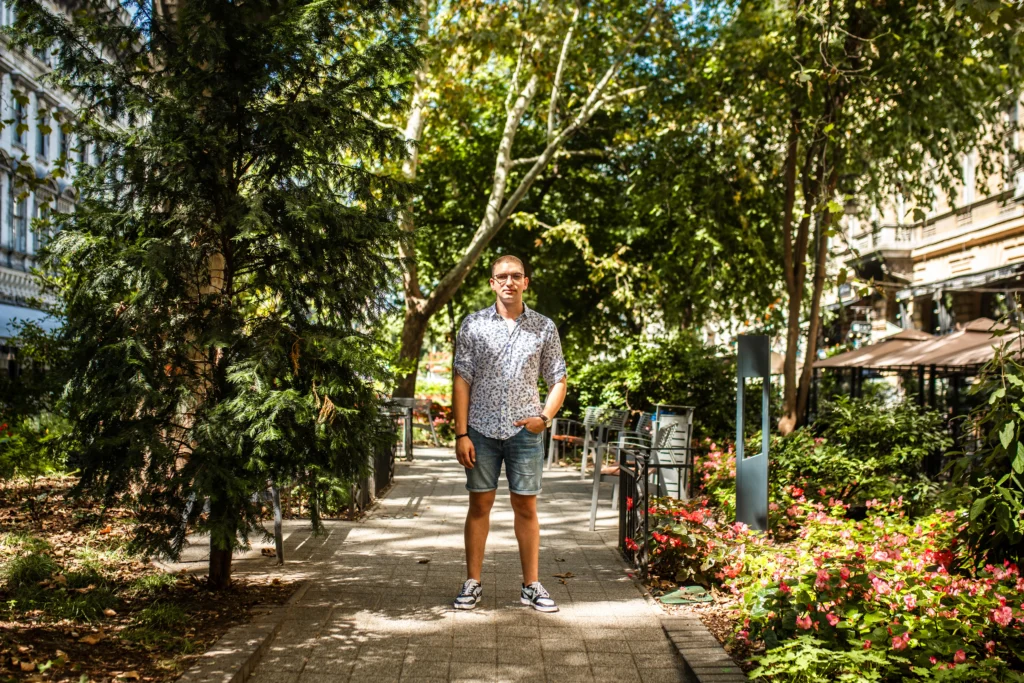
At the joint composer competition between the Budapest Festival Orchestra and Budapest, the Junior Prima prize winner Patrik Oláh won first place, so he wrote the capital’s overture. The work will be presented by the Budapest Festival Orchestra on September 2nd at a large-scale, free outdoor concert in Hősök Square, thus celebrating Budapest’s 150th birthday. And we contacted Patrik Oláh to tell us a little about the play, but even more so about himself. Childhood, the academy, the first Mass in Lovári in music history, Budapest and the Black Eyed Peas – we talked about these things with the young composer.
– At the age of seven, how does a child from Salgótárján decide to become a musician, while his peers are still vacillating between becoming soldiers, firefighters, policemen or superheroes?
– Such a career never occurred to me, and I looked at my classmates who wanted to be police officers as strange. Anyway, everything could tie me down, but not for long – but music was what I could linger on for a long time. My cousins also learned to play music, and I remember that my parents once came home from a concert saying how good they were and how proud they were of themselves.
– Just don’t say that childish jealousy took over!
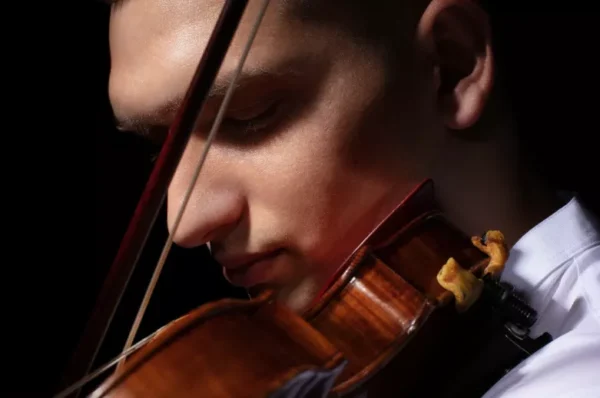
– No, they were more excited. I said then that I would also like to play music, although at that time I had no serious connection with music. However, I started playing the violin at the age of seven, and almost everything made sense to me then.
– Did you stand up to your parents and say, Dad, Mom, I’ve decided that I’m going to play the violin from today?
– No, I originally wanted to play the piano, but my parents told me to play the violin instead. In addition, I didn’t start at the beginning of the year, but during the year, so I couldn’t enroll in a piano class, but I could enroll in a violin class, so I started playing the violin. Later, of course, I also took up the piano, so I didn’t regret playing the violin at all.
– And that automatically took you in the direction of classical music?
– What I really liked about classical music is that it is not monotonous and schematic. Irrespective of the fact that baroque music and classical music are quite schematic, but in a different way than light music. I didn’t really listen to light music until I was seventeen or eighteen years old
– Wow!
– Yes, I’m making up for that right now. But anyway, that’s not completely true either, because I listened to Black Eyed Peas with Fergie, I’ve always loved them very much. But apart from them, I only listened to classical music.
– And within that?
– My first period was more defined by Vivaldi, but I also liked Bach. Then the romanticism came later, which remained with Tchaikovsky, who has been my favorite since I was 12 years old. And when I started paying attention to light music at the age of 17-18, I also started paying attention to 20th century music, Bartók, Stravinsky.
– Did you make it to Kurtág and Ligeti?
– Why, and I didn’t just start listening to, for example, Ligeti, but also interpreting it, so you could say that I managed to get to know them and this line of modern music during my undergraduate studies.
– Classical or classical music is imagined by laymen as working according to terribly strict solutions and traditions, and concertos can only be composed with a dead serious face. Experimentation is something that exists here as well, which you also practice by weaving authentic gypsy music into your works. To what extent does experimentation work in classical music today?
– I think this is no longer the main direction and I would separate the fusion from it. Rather, the second half of the 20th century was characterized by experimentation with sawing a piano apart, or what John Cage did with 4’33, or Ligeti with metronomes. In the 21st century, I feel that the composers should rather include the aspirations of the last century or bring them back into the music of today. If you ask me, I think music is pure in this sense and not, like in the 20th century, that everything is a twelve-step, in which all 12 notes are present, either above each other, next to each other, whatever. I think that music needs to be made more accessible now.
– Why have we gone so far with experimental music?
– Yes, and because of that, I think to some extent the connection with the audience has been lost. Of course, at the beginning of the 20th century, popular music did not exist in this form, but snobbery did, and it could function that way, but today I think it has completely disappeared. As a result, we classical music composers have to do what we can to get people to come to concerts again. And so we still have a lot more to do.
– Are you saying that classical music should be moved towards light music?
– No, but I would like to add that my plans also include producing things, especially in the direction of electronic music. But that’s another thing.
– We mentioned that the fusion of classical music with Gypsy music is a kind of sign. Is this a mission on your part, or are you so deeply inspired by gypsy music?
– Given my background, I think both arguments are valid. But it’s an interesting thing, because somehow, when I write my pieces and read them back, I see that the basis of all of them comes from gypsy music. Now I can incorporate this more and more, and I can also highlight it in such a way that it works well. Regardless, I also consider this direction good because in the 20th century almost no one dealt with gypsy music, with the exception of operettas, but I wouldn’t consider this part of high culture, even if I like them anyway. So I think that there is a lot of potential in this, as it is still possible to collect a lot of Gypsy folk songs, which can hardly be said about the music of other peoples nowadays.
– Is that what you intend to do?
– It is definitely my intention, but it requires a lot of money, a lot of energy and a lot of people.
– Is there any support for this? Do you have any support at all for the creation and presentation of your works?
– So far, I have never received state support, despite the fact that I have submitted any application. I don’t know what the reason is, but I think it makes me even more creative, since I have to find completely different solutions in order to be able to present my new work. I could also say that I have to find the way for this myself, because from the age of 20 until now, I tended to hope that it would start by itself, but now I realize that it doesn’t work that way. But that’s it, it has to be done.
– Even so, you can count on significant success. Your work, presented at the 2021 International Eucharistic Congress, became the first mass in the history of music written in the Lovár language. How does a composer in his early twenties achieve this?
– This is an exciting question, because sometimes I don’t even know how it could have happened. I had a teacher at Bartók Konzi, György Lakatos, with whom I have been very good ever since. He was my chamber teacher and I talked a lot about composing with him. After that, I became a composer at the Academy, the first successes and competition results came, and he had to find a Roma composer with this opportunity who is reliable, can do it and doesn’t see it as a hack.
– So it was a conceptual request?
– Yes. The Bible was recently translated into the Lovar language, thus giving birth to the Romani Mass, the text of which was also approved by Pope Francis. Then came the opportunity to set this to music.
– How old were you then?
– When I got the chance to go to mass, I was twenty years old.
– And what happens when they stand in front of you, so that you have the opportunity to set the first Cavalry Mass to music in the history of music?
– Well, I didn’t realize that then. But it also means that I spent an entire summer thinking about how to approach him while I was coming off a very difficult year at the Academy and planned to party all summer. But in the end I solved the task quite well – at least I think so.
– How did you come up with the possibility of writing the Budapest Overture?
– Well, mostly by trying to see if it works. And he came in. And I think I have a pretty good sense of where the cross-section of what the jury wants is, and what I can use to include everything I want. And maybe it won because everyone thought that for this competition a very simple major-minor, fanfare-like, signal-like thing should be written, which is also present in my work, but I included the sound world of the great predecessors of the 20th century, for example micropolyphony, or by the Bartók concept.
– How can the unification of the three cities and the complex cultural-historical-urbanistic identity of the capital be incorporated into a piece of music?
– The whole play consists of three parts, which could already be deduced that there is Pest, there is Buda, and there is Óbuda. But this was not the main direction, but rather the fact that Pest, Buda and Óbuda had already been tried to unite several times, and yet they succeeded only on the third attempt, 150 years ago. I wanted to present this adversity, as well as the atmosphere of the time since the unification, from which I singled out Trianon, which is talked about in many different contexts these days, but this historical tragedy was always an important question for me, and I definitely wanted to reflect on it. But it includes the Soviet oppression, first the period of the Austro-Hungarian monarchy, then the regime change and the time of freedom – which, however, is up to everyone to decide for themselves how much they experience as freedom.
– You have been living in Budapest for quite some time. How do you see the city and how does it affect you?
– In September, it will be 11 years since I have lived here and it was very impressive to know that I moved here. Seen from Salgótarján, Budapest is huge, the population of my hometown is as large as that of a district here, so this had a very big impact on me. It was very interesting that there are people on the street at night, or that after a concert you can still sit down and drink a beer in one of the pubs on a Tuesday night. The city has become very close to my heart, and especially the Danube. Ever since I’ve lived here, I’ve had a very close relationship with the river, I go there a lot just to think.
– In music?
– Also about music, but sometimes just thinking about nothing. But it really happened more than once that I had to write a play, and I just sat there on one of the steps facing Margitsziget, wrote down a few sounds, a few emotions, and finally the play was born. Now, anyway, I sometimes feel that the city is perhaps a little too busy. Besides the abundance of music, the silence is sometimes nice, but that still makes Budapest very much in my heart.
(Featured image: Ruzsa Rania/Főváros)
The original article is available at: https://enbudapestem.hu/2023/08/28/sokat-kell-tennunk-azert-hogy-az-emberek-visszajojjenek-a-komolyzenei-koncertekre
The article can be downloaded: Oláh Patrik_ Sokat kell tennünk azért, hogy az emberek visszajöjjenek a komolyzenei koncertekre